
T.H.E. Show – Summer 2026
Audiophile trade shows used to be a mandatory part of my yearly schedule. They represented an opportunity to show off our latest productions, demonstrate real high-resolution audio in full 5.1 surround sound, meet attendees, maybe participate in a seminar, and hopefully sell enough discs to cover the costs of the show. For many shows, I could barter my time presenting for a discount in the cost of a 10 x 10 booth in the marketplace. However, with the rising costs of travel, the increased cost of the booth, and the fact that I haven’t had anything new to sell has meant that participating in audiophile trade shows has become a fond memory. I just couldn’t justify spending the entire weekend hawking my wares to break even or lose money. What was once fun, new, and exciting turned into a chore.
I’ve loaded up my two rolling suitcases many times and flown to AXPONA in Chicago, travelled to New York City multiple times, and even done shows in London, Munich, and Paris. Those were the days. But I’ve always held T.H.E. Show in very high regard for a couple of reasons. First, it’s close – or relatively close – to where I live thus avoiding the high cost of a hotel room and a plane ticket, the people who run the show Emiko and Maurice are the best at what they do, and I’ve always been offered a trade for the cost of the booth by giving a presentation or two. If anyone has experienced my seminars, I’m confident you’d acknowledge that I enjoy sharing my “wisdom” on all things audio AND often confront controversy head on.
So, when my good friend and fellow audio trade show refugee Roger DuNaier gave me notice that T.H.E. Show as coming up, I headed to their website and purchased a single day ticket for the opening day, Friday Jun 26, 2026. Roger’s car was loaded with three other audiophiles, so I drove myself to the Hilton in Costa Mesa to arrive around noon. Fridays are typically an opportunity for press and VIPs to visit the rooms and get a jump on what’s new and compelling.
Emerging from the lowest level of the underground parking, I wondered in – and out – of a couple of ballrooms on the lobby level before happening on the Synergistic Research room. I’m pretty sure Ted Denny didn’t recognize me as he went about extolling the virtues of his latest innovation. If you’re not familiar with the product line of Synergistic Research, do a Google search, read some of my past posts, and seek out some of the heated exchanges on audio forums. To put it mildly, Ted is a controversial figure in the world of high-end audio. Some might call him a seller of “snake oil.” And his latest expensive piece of gear lives up to his reputation.
AI & Metadata Take Control
I didn’t take down the actual name of the 6-foot high “carbon fiber” rectangular tower with the bright LED On/Off light sitting behind the assembled audio playback system. Ted was keen to point out that he left his most expensive components, cables, and speakers behind. He was confident that his latest technical development would elevate his “modest” system to state-of-the-art performance. This piece of gear weighs heavily on “AI” and metadata, of course it does, and apparently has garnered the interest of Samsung and other tech companies. By Ted’s description, it creates an electrical “shield” or anti RF bubble around the equipment and cables to counteract the negative effects of the microprocessors present in the space without being in the signal path. And it can alter the degree of its beneficial field by merely talking into the app with directives like, “smooth out the high frequencies, or “increase the sound field depth.” In each case, Ted switched the tower on and off after asking for the AI alteration. Unfortunately, it takes about “10 seconds” for the device to accept the commands and regain its full effect during. There is no immediate A|B comparison.
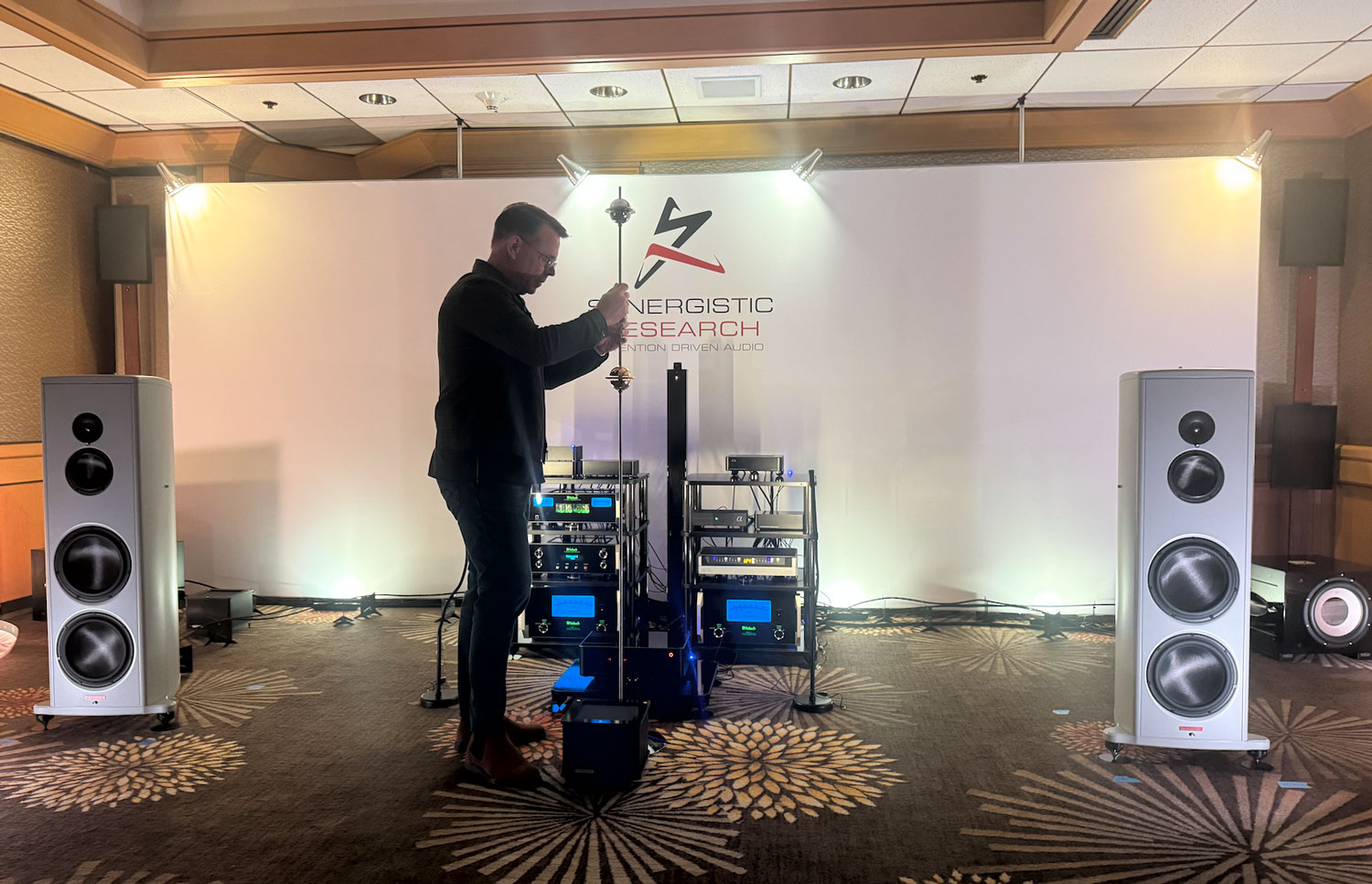
Ted Denney making an adjustment in their demo room.
I was sitting in the front row and heard absolutely no change in the playback of “The Sultans or Swing.” I can’t speak for the others gathered in the room but if a dramatic change had occurred, I think someone would have chimed in. Additionally, each track accesses some metadata unique to that album/track. Thousands of data points attach to the Dire Straits track, which maximize the fidelity and playback integrity. I asked where does all the metadata come from? Ted pointed to the display over in the corner and told the crowd he personally came up with all the “thousands” of data points for each of the tunes in his catalog. I didn’t bother asking a follow up question. You can judge for yourself whether any of Ted’s claims have merit. I made up my mind years ago. Other audiophiles feel differently because Ted (and others) continue to sell expensive “components” to them. Ted lives a very comfortable lifestyle thanks to his ability to develop innovative – and utterly ineffective – devices.
Analog Reigns – Tape and Vinyl Sources
It took only a few hours to survey the entire T.H.E Show. My memory may be failing as I age, but it seemed like the show was substantially smaller than during the years I exhibited. There was no line at the check in and plenty of empty chairs in the demo rooms. There were lots of smaller rooms on the 2nd floor, the marketplace (which was home to only a few vendors), and the ballrooms on the 1st floor and mezzanine.
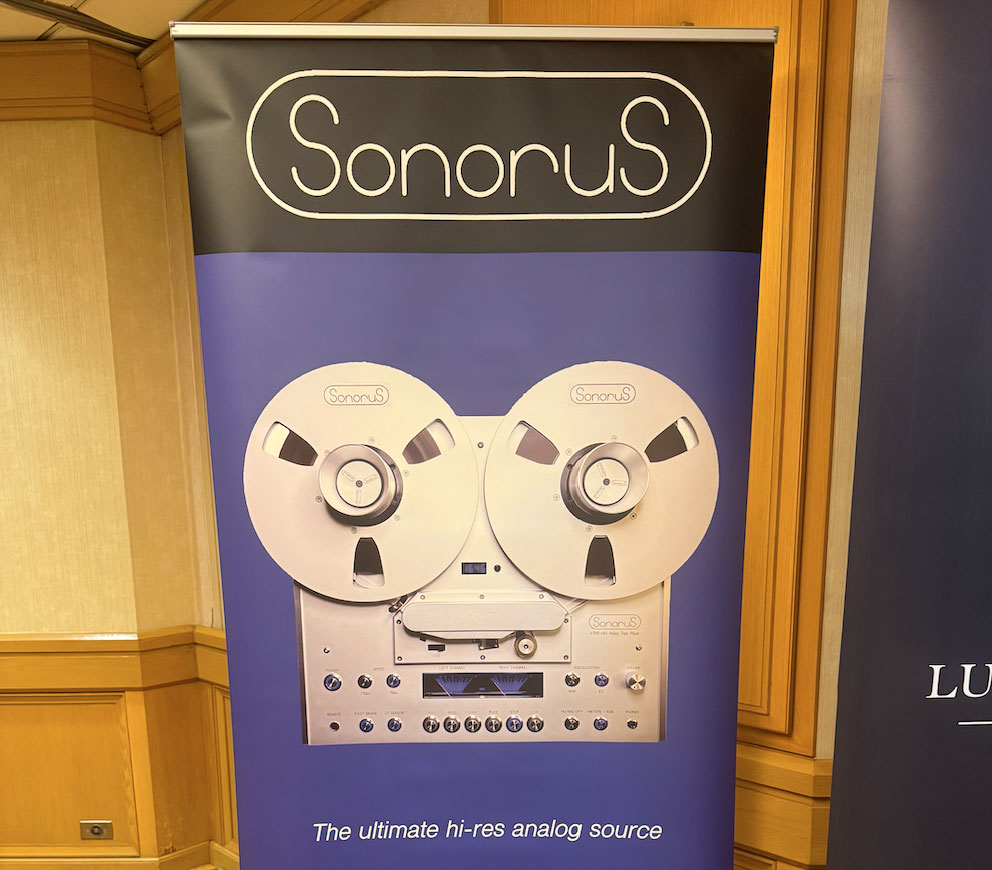
I guess I shouldn’t have been surprised at the popularity of analog tape and vinyl as the formats of choice among those demonstrating high-end audio equipment at the show. One representative touted their completely remade Revox reel-to-reel machine. All the reproduce electronics, equalization, and playback amplification circuits were redesigned and replaced. The machine looked gorgeous and perhaps that’s the point because the performance specifications of these reproduce-only machines playing third generation analog copies of safety copies of master tapes fails to match the specifications of even the cheapest compact disc player.
I can appreciate the allure and fascination with analog tape, but the value proposition just doesn’t pan out. One of thing pieces of equipment that I would never have given up or sold was my Nagra IV-S stereo tape deck with QGC large reel adaptor. They both burned in the Palisades fire but if I had been there that fateful day, they would have been among the first things I put in my car. Sadly, I was in Durango on the day of the fire. It was my little Ferrari tape deck. It went to the jungles of Costa Rica, the remote villages of Haiti, and hid inside my briefcase when I made surreptitious recordings in the Japan American Theater downtown.
Another room featured a high-end turntable and associated electronics. The pursuit of audio perfection from a rotating piece of vinyl continues to engage audiophiles and makers of both hardware and software. OK, I appreciate the nostalgia associated with vinyl albums and turntables. I recall fondly my AR-100 turntable, which I acquired as a university student in the early 1970s. But if you’re going to count on vinyl as your source of choice, I would suggest vendors select dense recordings with uniform dynamic range. One demo I endured played a very sparse track consisting of percussion and flute. The amount of “snap, crackle, and pop” coming from the speakers was at least equal to the music. Is vinyl worth the effort it takes to keep your discs clean and free from dust and scratches? Digital sources don’t suffer these imperfections.
Stereo vs. Surround
It was only on our way out of the show after lunch that we trucked back a ballroom where the vendor had promised to demonstrate electrostatic speakers in a Dolby Atmos spatial playback system. The poor guy took us behind the curtain where there were boxes and crates of equipment that would have made such a room possible, but nothing was unpacked. The poor vendor from Phoenix told us his “helpers” all bailed but that he and his son (who was sitting on a box listening to his ear buds) would try to have the system up and running the next day. I give the guy an “A” for effort and inspiration. Finally, an audio retailer with a vision for the future.
During those years that I cobbled together a ballroom demo system at AXPONA, I assembled a high-resolution, 5.1 surround, audio/video room with contributions from B&W, Oppo, JVC, Audience, Benchmark Digital that provided attendees a true state-of-the-art audio/video experience. T.H.E. Show last week was a visit to an audio past. There was no headphone gallery, personal audio section, no seminars on streaming high-resolution or surround audio AND no one under 50 years old. If our hobby is to survive, the shows and publications should make an effort to reach out to the younger generation and appeal to women.
I’m a Pilot!
My father was a pilot during WWII. At just 20 years of age, he was a captain in the Air Force flying B-17 bombers over Italy. After the war he was employed by General Motors as a pilot flying executives around the country. He loved flying and I got the bug too. It’s been well over 50 years since I lost him to cancer, but I know he would be proud of me this past week as I completed my check ride and became a private pilot. It was the culmination of many years of training and effort, starts and stops, interruptions, and a recent near-death experience during last month’s check ride continuation.
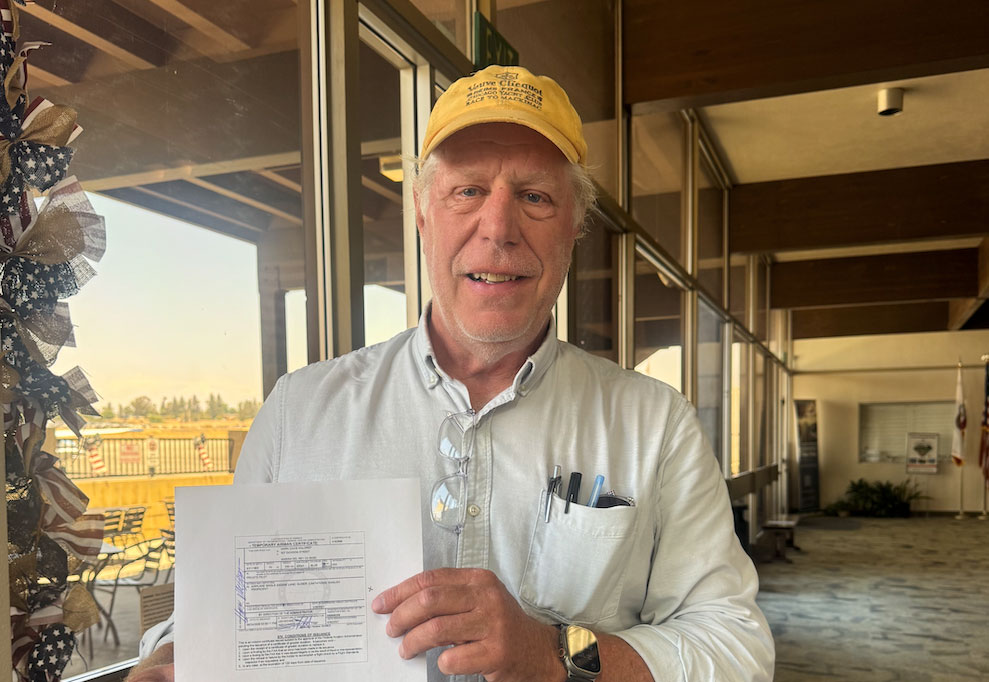
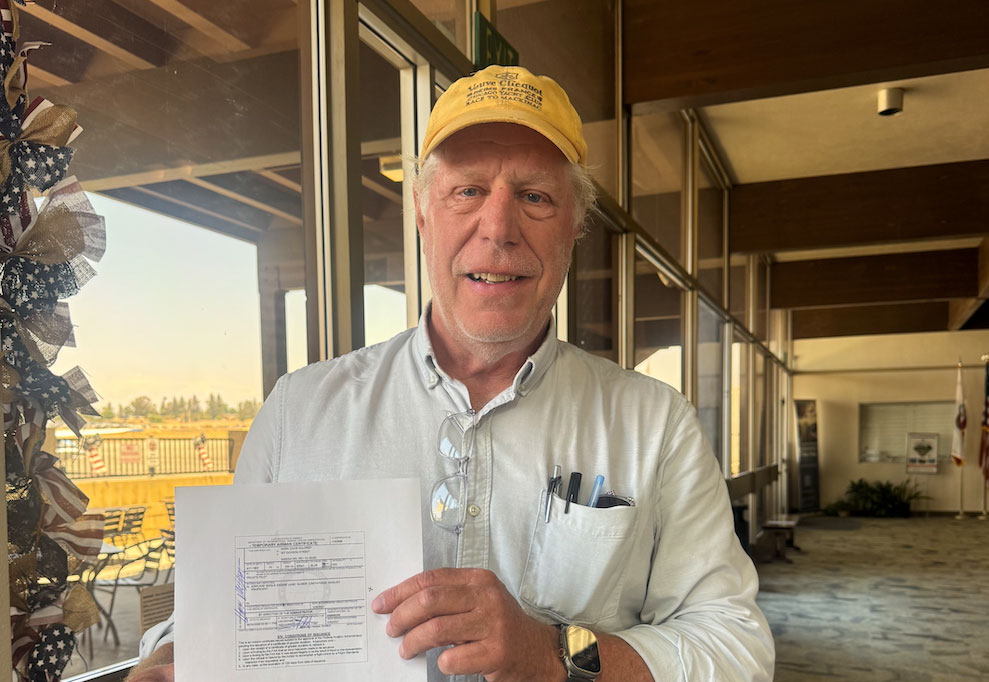
After my retirement, the loss of my house, my impending divorce, and reduction in operations of AIX Media Group and my record company, I decided to pick up where I left off back in the 1990s and early 2000s and return to flying. I started my training at Burbank airport and had accumulated about 30 hours during those years including a cross-country trip to Las Vegas. This time I hooked up with the Santa Monica Flyers folks out of KSMO – Santa Monica Airport, which is only 15 minutes from where I’m living while I figure out how to rebuild my house in the Palisades. I’ve been studying and flying for about a year since the restart and last Wednesday, my Designated Pilot Examiner shook my hand and signed me off to fly! I added certification for single engine land airplanes to my glider certificate.
A check ride is the final step at each major milestone in one’s progress from student pilot to full captain working for a major airline. You must be a certain age, able to speak and understand English, pass a medical exam (they check your eyes too!), pass a written test, and have minimum of 40 hours of actual flight training. I’ve been working with Efer over these many months. We’ve been training in a light sport airplane designed and manufactured in the Czech Republic. It’s a great trainer, inexpensive, and has a 100 hp Rotax 912 4-cylinder engine. Practice sessions were held up the coast from Santa Monica just off the coast of Malibu, home of the rich and famous. On the trek up and back from the practice area is Pacific Palisades – or what’s left of it. While it’s true that there are over 1300 newly framed houses popping up in my old neighborhood, many of the lots are still empty and waiting for someone to build a new house. Just like mine.
I’ve checked off all the boxes during this past year. I passed the written test and the medical exam. I’ve accumulated the necessary hours (about 80 so far), done the cross country and night flying, and soloed for more than the minimum number of hours including a flight to Santa Barbara. So about two months ago, Efer deemed me ready to attempt my own check ride with an experienced pilot and DPE based in Riverside, California, which is a 35-minute flight east of Los Angeles. I was pleased that Leo Bell agreed to come to Santa Monica on the 29th of April for my exam. He checked my log, reviewed all the necessary paperwork, and started the oral portion of the test. No problem discussing air space, light signals, colors on the pavement at the airports, etc. In fact, the oral exam was easier than I thought. A break at noon and we were off to the flying part of the test.
I climbed into Sportcruiser 4385MR and went through the preflight checklist. Leo joined me and attempted to plug in his headphones and microphone. Headphones play a big role in flying with clear communication over the engine noise being among the primary reasons. I have a very nice active noise cancelling Bose aviation headset and so does Leo. Unfortunately, his jack would not “lock” into the appropriate jack. We tried for a while, swapped headsets to no avail. The tech people secured a new jack but after 45 minutes, Leo was anxious to begin his drive back to Riverside. Oh well…my check ride was “discontinued.” I expected and hoped we’d pick it up the following week, but I was forced to wait a month until he was available to pick up where we left off.
On the 28th of May, which is a notable day in my family calendar as it’s my older brother’s birthday, I was scheduled to continue my check ride…this time in Riverside. I got up early, preflighted the plan, made my radio calls, and flew the 30-40 minutes to Riverside. My plan was to get there early and have breakfast before heading to Leo’s upstairs office. At around 11 o’clock in the morning, we headed out to the plane. The headphone jack was fixed. Leo directed me to fly from KRAL east to an area north of March Air Force base to do the required maneuvers. I wasn’t perfect but I demonstrated slow flight, steep turns, simulated emergency procedures, stalls, and more. The only thing left was some alternative take offs and landings.
Unfortunately, Riverside was too busy that day and we diverted to Flabob airport, a little non-towered field only a few miles north of Riverside. As I was to find out later, this place has been there for over 100 years! I landed after slipping on final (turning the plane sideways to quickly lose altitude – a required maneuver) and immediately took off again. Another trip around the pattern and a successful short field landing before adding power and heading around again. After my third and final landing when we were about halfway down the runway, I pushed the throttle full forward. We accelerated down the remaining runway, took off, and began to climb to pattern altitude when the engine immediately began to sputter and choke. We had lost power during take-off at about 175 feet above the ground. The mantra taught to us during training is to land straight ahead without trying to return to the safety of the runway because the plane is too low, you’re likely to stall and enter a life-ending spin, and hitting an obstacle is very possible.
We both recognized the situation was a real-life emergency but there was not time to carefully go through the “engine failure” checklist. I had already done that when we were 3000 feet high. Leo called out to take control of the plane and he took over. I looked out ahead thinking we would try to locate an open field or unobstructed roadway (not too many overhead wires) to land on. But no. Leo immediately banked the plane to the left in an attempt at performing what referred to as the “impossible turn.” Look it up on YouTube. It kills a lot of pilots and passengers every year. One that I viewed recently killed two pilots in Lake Placid…both experienced pilots. One was the founder and head of the Air Safety Institute. He and another pilot died trying to make a turn back to the airport…and they were higher than we were when our engine failed.
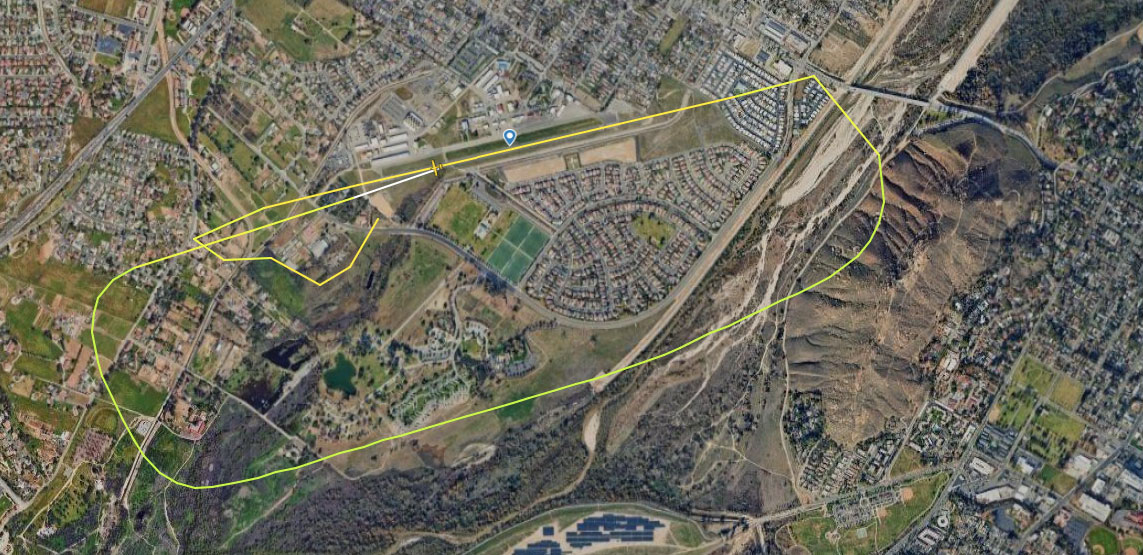
The jagged line is the path of our final trip around the pattern without power.
The image above shows the path of our final circuit around the airfield AND the abbreviated one that could have resulted in a deadly crash. There is a fair amount of open territory but as Leo later explained to me, we couldn’t land because we were too high. I sat in the left seat watching opportunities to reach an open field appear and then disappear. But Leo kept turning and flying. As the runway came into view, I noticed a set of power lines dead ahead. There were trees on both sides with a rather narrow gap in between. At this point, we were committed. Thankfully, we had maintained enough speed to clear the power lines by at most 10-15 feet. A final turn to line up for the reverse runway and we were safely back on the ground. What an incredible feeling. To survive a very serious emergency.
But I had to discontinue yet again. With only one more landing to complete before getting my certificate (a soft field landing), I had to accept that the little Sportcruiser wasn’t going anywhere for a while. It wasn’t flying again for another month. This time with new carburetors. I completed my PPL (private pilot license) on Wednesday June 24, 2026, in Riverside. One trip around the pattern took almost the entire day. I also learned that day that outdoor diners at the Flabob airport saw us barely clear the trees and called 911 and that the Riverside police immediately dispatched a helicopter to locate our crash site and provide whatever help would have been possible. But luckily, they saw the plan back on the runway…in one piece.
Will this experience dissuade me from continuing to fly? No. I figure I’ve been through a real-life emergency and survived to write about it. I’ll continue my training and strive to be the safest pilot I can be.
Missing AIX Records Discs – Can You Help?
I mentioned in my last post that I have managed to collect at least one copy of every disc AIX Records produced and released…except a couple. Thanks to a customer in Europe, I was able to secure an .ISO file of the Mozart Symphonies No. 26 & 41. However, I’m still in need of the Debussy, Glinka & Others – Music For Solo Harp – Ion Ivan Roncea AND the 2017 HD-Audio Sampler Blu-ray Disc.
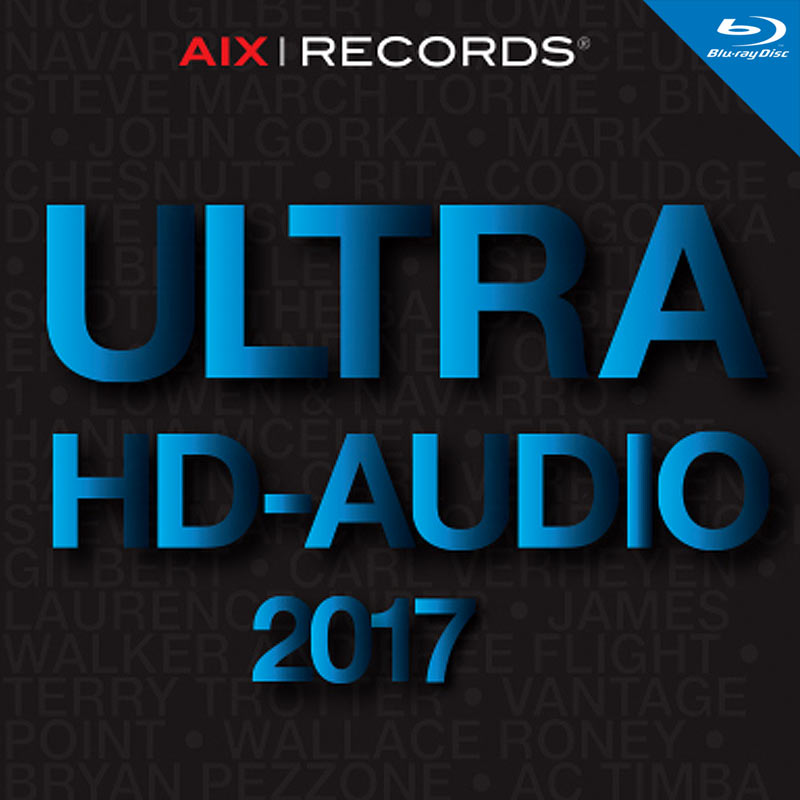
I handed out thousands of this very special disc. Unfortunately, the one copy that I managed to find is damaged and will not mount or let me clone a copy. The disc has portions of 85 different tracks complete with alternate mixes AND video.
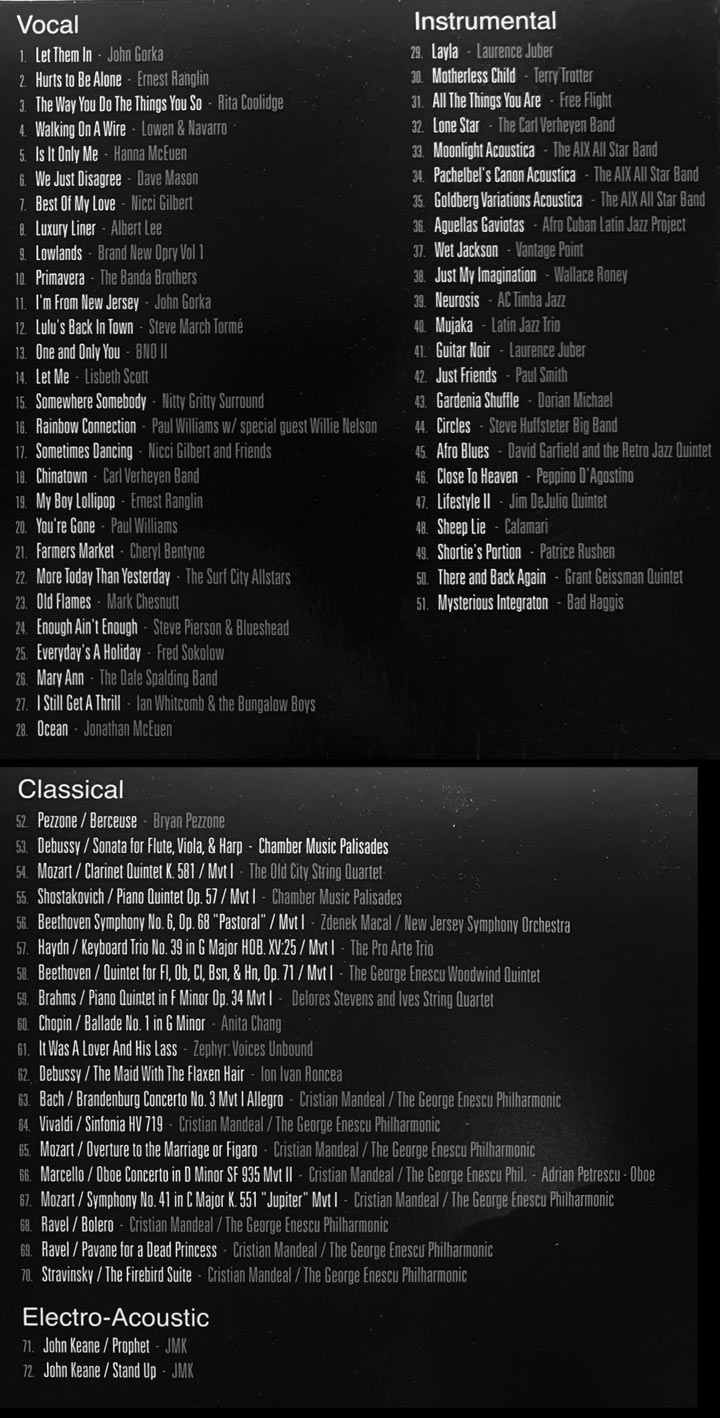
If you have a copy of this disc and are willing to let go of it, please let me know. I really need one.
I completely understand that feeling. It’s a shame how much they’ve diminished, but the anticipation before a show like this is still really exciting.
A BAACH system was playing in the “other” ballroom next to the surround sound room. The technology works.
The speakers without crossovers (Audience & Wolf von Langa) may have interested you.
Companies like Audio Note and Triangle Art focus on the older ways and older sound, not HD, but they’re not pretending.
Please address the word or impact of “musicality.” Some rooms have it, most don’t.
The BAACH system is remarkable but limited just like the YARRA 3DX was…you have to sit in specific places to get the effect. I don’t disagree that most companies embrace the older technologies and believe in them. As for musicality and playback systems, there are no specifications and each individual hears things differently.
Wonderful seeing more writings from you Mark! And even a show report describing the sounds and equipment of the past that some still hang on to as if these anachronistic things represent the best fidelity one can achieve. Average age of participants certainly telling.
Ted Denney and his push into “AI” is a sad example of the man jumping on a bandwagon with no self-awareness that he comes off poorly. As usual, coming off transparently as a charlatan – amazing how some people can shamelessly create a career of doing this!
While the traditional audiophile press rarely writes about multichannel these days, that’s OK because those of us with surround systems are enjoying a good amount of mainstream and popular content out there even if the content is EAC3-JOC Atmos from sites like Apple Music, typically with better dynamic range than the stereo mixes. Understandably, can be difficult to get a good multichannel system set up at audio shows for just a few days. Good on you for having done this at AXPONA. Would be nice if some of the remaining brick-and-mortar local audio dealers are able to showcase multichannel systems for their customers.
Stay safe in the skies, Mark! Congrats on retirement. Hopefully the stresses of life settle and we get to hear more of your thoughts on audio in the days ahead.